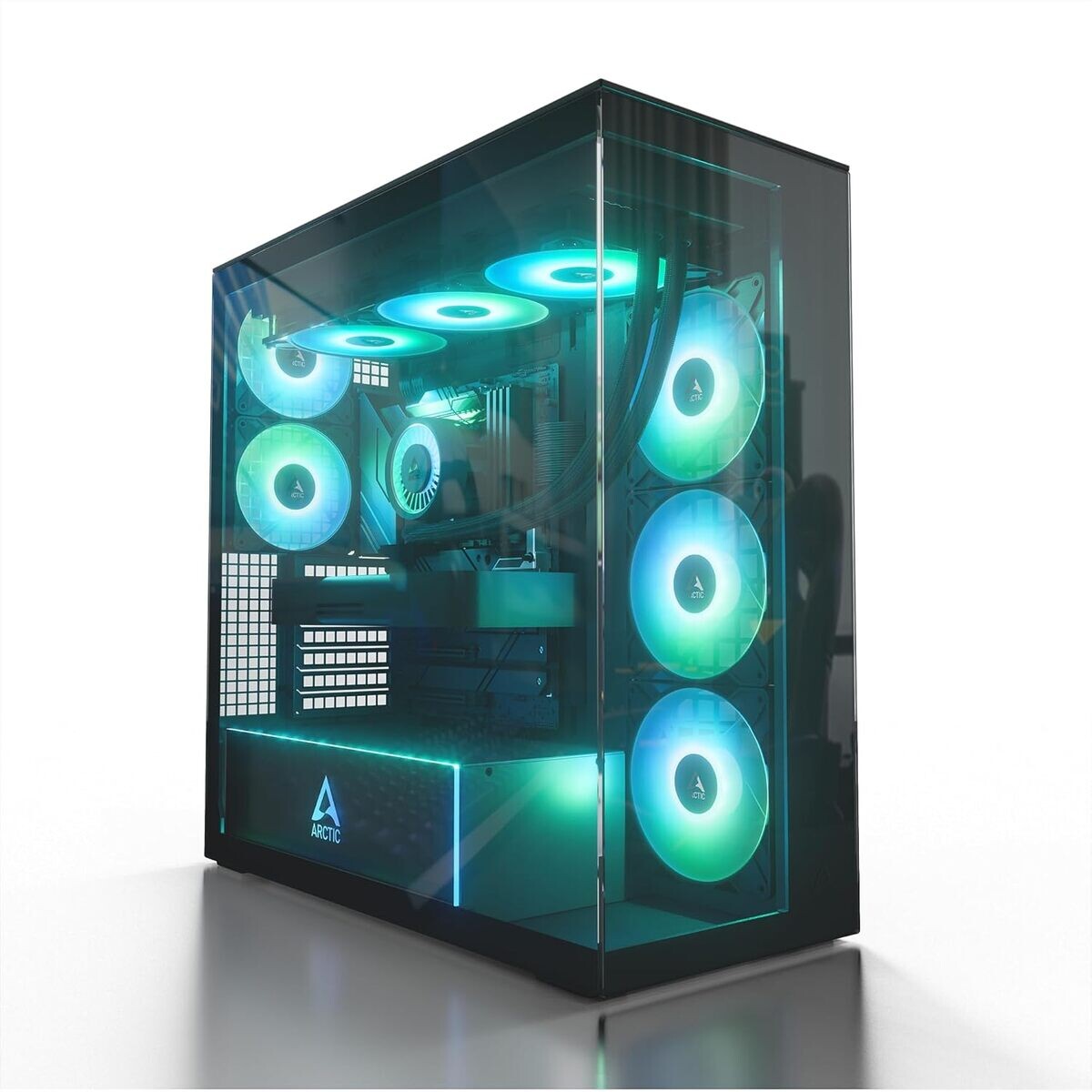
Arctic has expanded its mid-tower lineup with the Xtender Black (clear glass), a case that merges tempered-glass aesthetics with practical cooling flexibility. Unlike previous models, this variant prioritizes transparency while maintaining structural integrity through black SECC steel framing.
The design shifts slightly from earlier iterations, removing the front-left pillar to create an uninterrupted view of internal components. This choice is more than cosmetic—it allows for better cable management and a cleaner look when paired with ARGB lighting. However, the trade-off is a marginally stiffer build that may not appeal to those who prefer a softer touch.
Cooling remains a strong suit. The case ships with five Arctic P12 Pro (120 mm) and P14 Pro Reverse (140 mm) fans pre-installed, all featuring the latest ARGB sync technology. These fans are positioned along the top, front-right, and rear panels to optimize airflow without blocking radiator placement.
- Key specs:
- Form factor: ATX (up to E-ATX)
- GPU length support: 48.2 cm
- Radiator compatibility: Two 420 mm (top/front-right) or one 240 mm (rear)
- Pre-installed fans: Five Arctic ARGB (two P12, three P14 Reverse)
- GPU mount options: Vertical (V-G variant) or standard
The Xtender Black’s internal layout is one of its standout features. It accommodates motherboards up to E-ATX dimensions while leaving room for dual 420 mm radiators—either along the top panel or the front-right side. The rear panel can handle two 120 mm fans or a single 240 mm radiator, giving users options depending on their cooling needs.
Pricing starts at $159.99 for the standard model, with an introductory discount bringing it down to $119.99. The V-G variant (with vertical GPU mount) is listed at $189.99, while the Accelero Vertical GPU Mount itself costs $51.99 separately. Whether these prices justify the upgrade over competitors remains to be seen, especially with alternatives like Corsair’s FRAME 4000D offering similar transparency at comparable cost.
For data/AI workloads, the case’s radiator flexibility is a notable advantage. Longer GPUs and liquid cooling setups can coexist without sacrificing airflow, making it a viable choice for high-performance builds. However, the lack of confirmation on exact availability timelines leaves some uncertainty for buyers planning immediate upgrades.
Arctic’s move to clear glass in this series suggests a push toward premium aesthetics without compromising functionality—a balance that not all mid-tower cases achieve. Whether it succeeds will depend on how well it handles real-world airflow under sustained loads, but the specs point to a case built for both looks and performance.