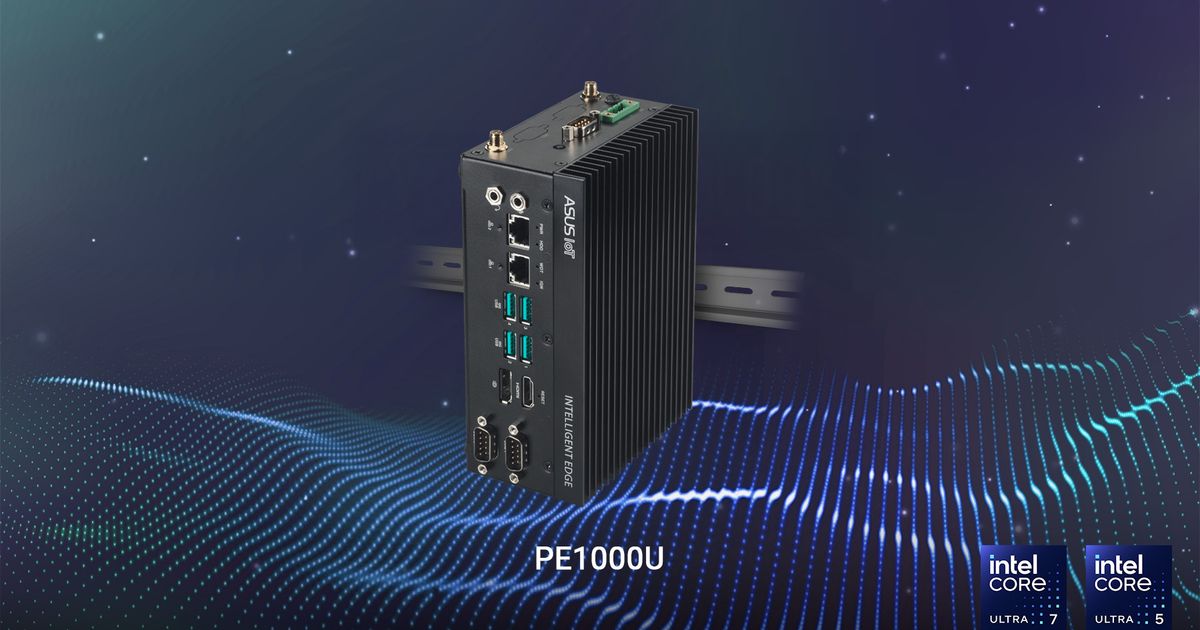
Industrial edge computing doesn’t need to be bulky. ASUS IoT’s new PE1000U is a DIN-rail mountable industrial PC that crams Intel’s latest Core Ultra 265U processor—along with hybrid CPU/GPU/NPU acceleration—into a chassis smaller than a hardcover book. Designed for environments where vibrations, dust, and extreme temperatures would cripple conventional systems, it’s targeting a niche that’s growing fast: autonomous mobile robots (AMR), collaborative robotics, and high-precision vision systems.
What makes it stand out isn’t just its size—63 x 110 x 160mm—but its ability to operate without fans or vents, even in temperatures from -25°C to 70°C. The tradeoff? It requires careful workload management, but the payoff is silent, maintenance-free operation in factory floors, warehouses, or even outdoor kiosks.
Built for What It Touches
The PE1000U isn’t just a repackaged consumer-grade PC. It’s engineered for industrial ecosystems where every connection matters. The front panel alone offers
- Four USB ports for sensors, cameras, or peripheral devices.
- Up to four COM ports (serial communication for legacy or custom hardware).
- Four Ethernet ports (two default to 2.5G) to link to LiDAR, motor controllers, or multi-camera arrays without bottlenecks.
- Dual CAN Bus for deterministic control in robotics or fleet management.
- Isolated DIO module to trigger strobes or illumination without electrical interference.
- DisplayPort and HDMI supporting dual 4K displays for HMI or machine-vision monitoring.
This I/O density is critical for AMRs, where a single unit might need to communicate with cameras, motor drives, and a central fleet management system simultaneously. The dual CAN Bus, in particular, ensures real-time synchronization for motion control—something collaborative robots can’t afford to lose.
Why No Fans?
The PE1000U’s thermal design is a study in passive efficiency. A wave-pattern aluminum heatsink conducts heat directly from the CPU and memory to the enclosure’s exterior, while a fully sealed chassis eliminates dust ingress and fan failures. The result? A system that can handle continuous vibrations up to 5Grms (meeting US MIL-STD-810H standards) without degradation. For deployments in logistics hubs or automated assembly lines, where downtime isn’t an option, this reliability is non-negotiable.
The tradeoff is power efficiency. The Intel Core Ultra 265U (or 235U) delivers hybrid acceleration for AI inference and graphics, but thermal throttling under sustained loads is a risk. ASUS hasn’t specified TDP limits, but the absence of active cooling suggests workloads should be optimized for bursts rather than continuous high-end performance.
Who Needs This?
The PE1000U isn’t for data centers or general-purpose edge tasks. Its ideal users include
- AMR operators: The DIN-rail form factor and 9–36V DC power input make it easy to integrate into forklifts or autonomous carts. WiFi 6E or 5G connectivity ensures seamless links to fleet management systems.
- Robotics integrators: The screw-lock connectors and vibration tolerance ensure stability in collaborative environments where human workers are nearby.
- Computer vision systems: The isolated DIO and multi-Ethernet ports simplify wiring for high-speed camera arrays or laser processing setups.
For traditional IT teams, the lack of traditional ports (no Thunderbolt, limited PCIe) might be a hurdle. But for industrial engineers, the PE1000U’s strength lies in its specialization—it’s a tool built for the exacting demands of automation, not a jack-of-all-trades.
Pricing and availability haven’t been announced, but with Intel Core Ultra 265U models starting around $500 for volume orders, it’s positioned as a premium but justified upgrade for mission-critical edge deployments.