ASRock has quietly expanded its NUC Ultra 300 Box lineup, introducing mini PCs powered by Intel’s latest Core Ultra 300 processors—codenamed Panther Lake. The update brings two flagship configurations: the Core Ultra X7 358H (16 cores) and the Core Ultra 5 325 (8 cores), both targeting AI-driven applications, embedded systems, and high-performance computing in compact form factors.
The new series replaces the older NUC Box 200 models and arrives in two chassis variants: the standard NUC (49mm thick) and the slimmer NUCS (38mm). While the core specs remain identical, the larger chassis gains dual 2.5G LAN ports and retains more USB connectivity, including Thunderbolt 4 and USB4 ports with Alt DP 2.1 support for external displays.
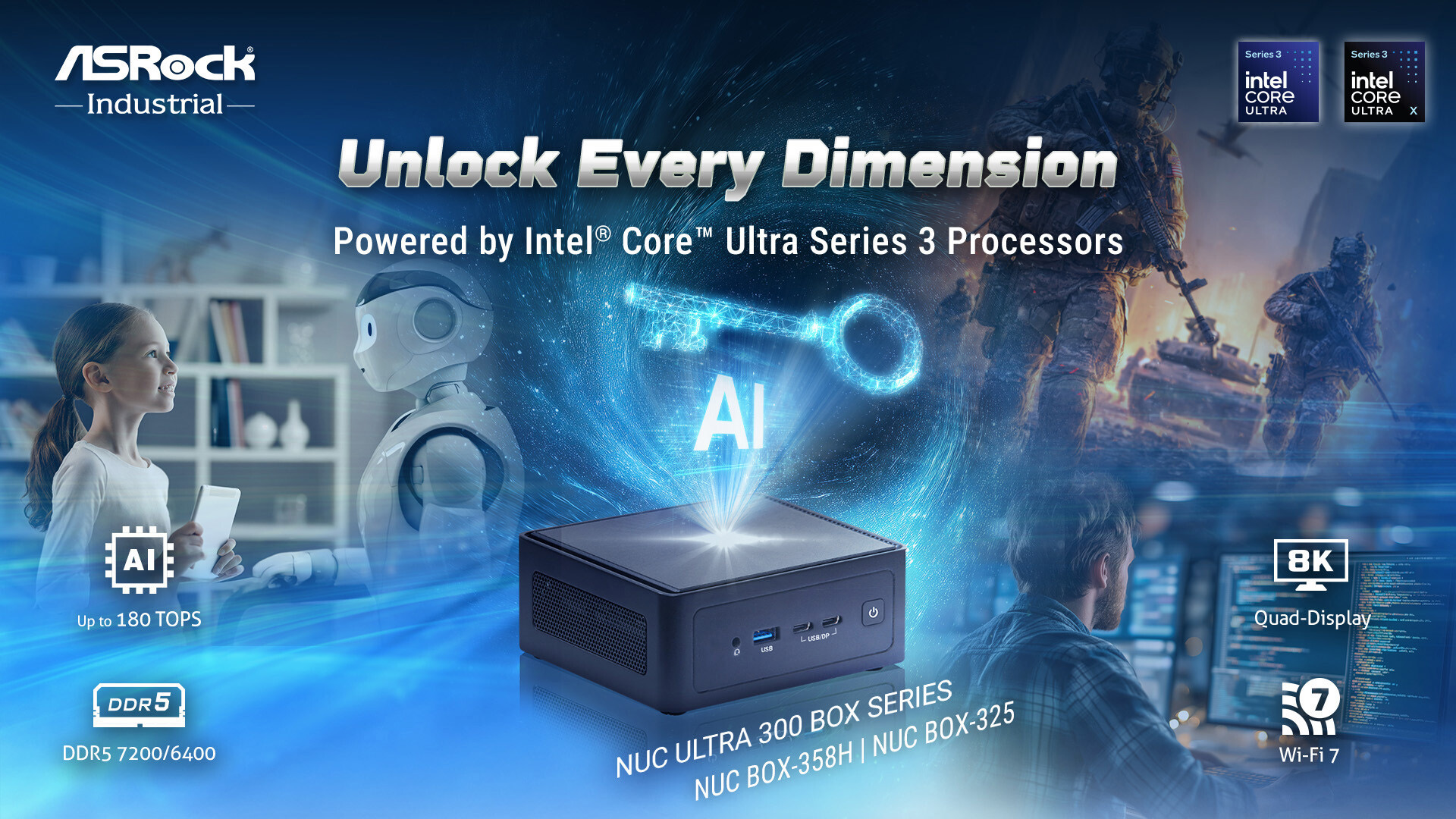
Key Specs: Memory, AI, and Connectivity
- Processors: Intel Core Ultra X7 358H (16 cores, 4+8+4 configuration) / Core Ultra 5 325 (8 cores)
- Memory: Up to 128GB DDR5 (SO-DIMM, up to 7200MT/s)
- Storage: 2x M.2 (PCIe 4.0) + 1x M.2 Key E (WiFi)
- Graphics: Core Ultra X7 358H features Intel Arc B390 (12 Xe3 cores)
- AI Performance: Up to 180 AI TOPS (combined CPU/GPU/NPU)
- Connectivity: Thunderbolt 4, USB4, 2x USB 3.2 Gen 2, USB-C with DP1.4a, dual 2.5G LAN (NUC only)
- Form Factor: Barebones, 49mm (NUC) / 38mm (NUCS)
ASRock markets the series as a foundation for next-generation AI workloads, with the Core Ultra X7 358H delivering the highest integrated performance in the lineup. The Arc B390 iGPU adds 12 Xe3 cores, while the NPU (Neural Processing Unit) accelerates AI inference tasks. For memory, the platform supports up to 128GB DDR5, a rare feat in mini PCs, catering to data-heavy applications like machine learning or real-time analytics.
The tradeoff for this capability is size: the NUC variant measures 49mm in height, while the NUCS drops to 38mm—both thicker than traditional ultra-compact desktops. Connectivity is robust, with Thunderbolt 4 and USB4 ensuring high-speed peripheral support, while the dual 2.5G LAN ports (in the NUC) improve network reliability for server-like deployments.
Pricing and availability details have not been disclosed, but ASRock’s focus on industrial-grade components suggests these will target enterprise, lab, and embedded markets where expandability and AI acceleration are priorities.