Moore Threads has crossed a critical threshold with its Yangtze SoC, a self-developed laptop processor that merges CPU, GPU, and NPU into a single 5nm chip. The architecture is designed to compete directly with Intel’s Meteor Lake and AMD’s Ryzen 8000 series, but with a twist: it’s optimized for AI acceleration from the ground up. The chip’s debut in the MTT AIBOOK—a $1,440 laptop with DDR5 memory and a 120Hz OLED display—marks the company’s first foray into mainstream APUs, but whether it can deliver on its potential remains an open question.
The Yangtze SoC’s most striking feature is its 50 TOPS NPU, a dedicated AI accelerator that could redefine how Chinese laptops handle on-device machine learning. While Qualcomm’s Snapdragon X and Apple’s M-series chips offer similar capabilities, Moore Threads claims the Yangtze’s NPU is fine-tuned for local language models—a critical advantage in a market where data privacy and regional AI frameworks are prioritized. The chip also supports PCIe 5.0 storage, a rarity in ARM-based laptops, and pairs with up to 64 GB of LPDDR5X RAM, though the reference AIBOOK ships with 32 GB DDR5-7500—a nod to traditional x86 performance benchmarks.
Performance benchmarks are conspicuously absent, leaving a gap that Intel and AMD have long dominated. The 12-core ARMv8 CPU runs at 2.65 GHz, but without synthetic or real-world tests, comparisons to competitors are speculative. The integrated MUSA-based GPU (Moore Threads’ in-house design) may struggle against NVIDIA’s RTX or AMD’s Radeon equivalents, particularly in gaming or professional workloads. Yet, the NPU’s efficiency could make it a standout for AI-driven applications like real-time translation, edge computing, or local LLM inference—areas where Chinese firms are heavily investing.
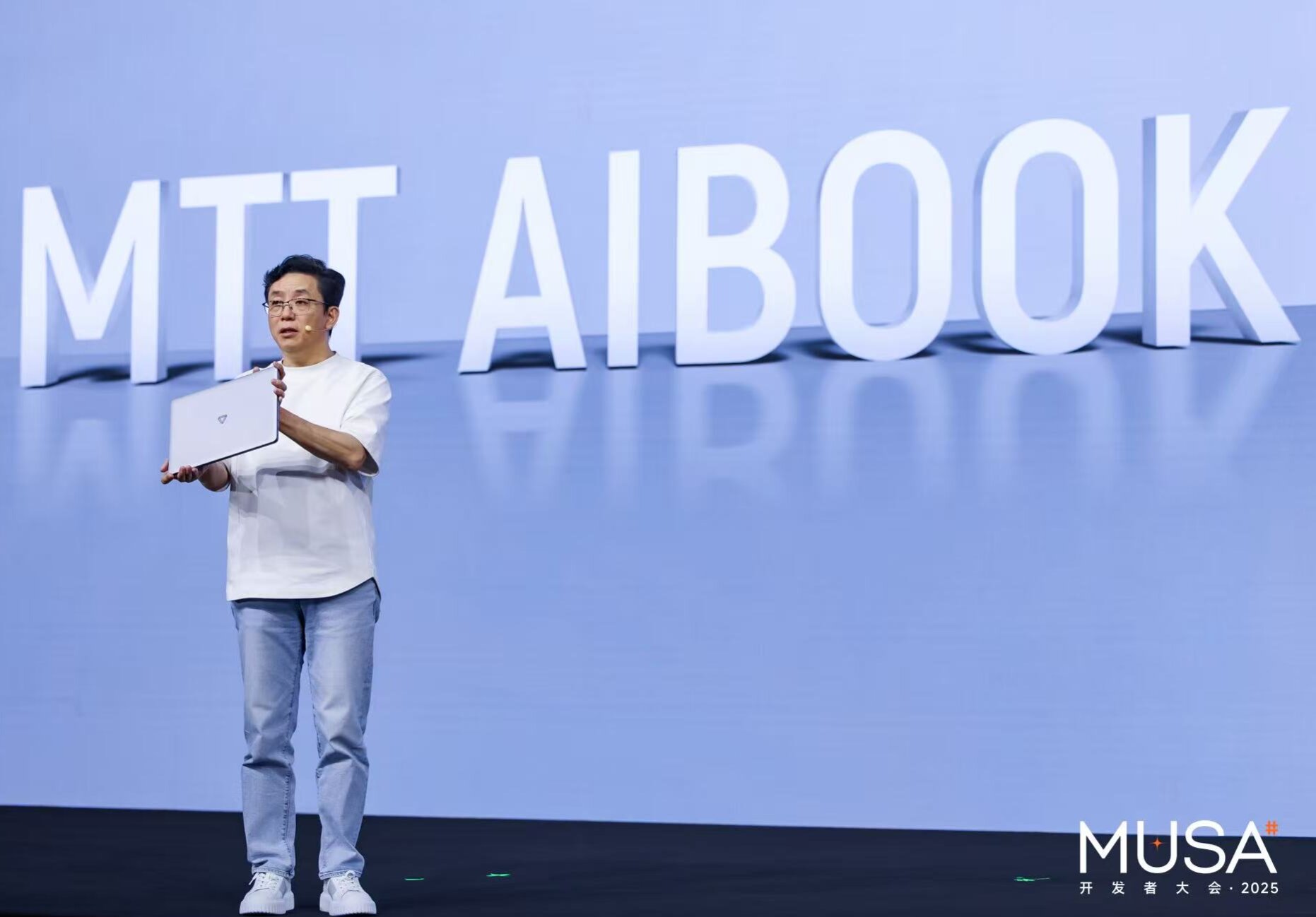
The MTT AIBOOK itself is a high-stakes product. Its 1 TB PCIe 5.0 SSD and 120Hz OLED panel position it as a premium device, but the $1,440 price tag mirrors high-end Windows laptops from Dell or Lenovo. The challenge for Moore Threads isn’t just selling one laptop—it’s convincing OEMs to adopt the Yangtze SoC at scale. If the chip proves reliable and power-efficient, it could attract partners like Huawei, Lenovo, or even domestic brands looking to reduce dependence on foreign processors.
China’s push for semiconductor self-sufficiency is the backdrop for this launch. The Yangtze SoC isn’t just a technical achievement; it’s a political one. With U.S. export restrictions tightening, domestic chipmakers are racing to fill the gap. Moore Threads’ success hinges on whether it can balance performance with power efficiency—a trait where ARM architectures traditionally excel. If the Yangtze SoC delivers on AI workloads while matching x86 rivals in general computing, it could redefine the laptop market in China and beyond.
The next few months will be telling. Independent benchmarks, developer adoption, and OEM interest will determine whether the Yangtze SoC is a one-off experiment or the start of a new era. For now, Moore Threads has made its move—but the real test is yet to come.