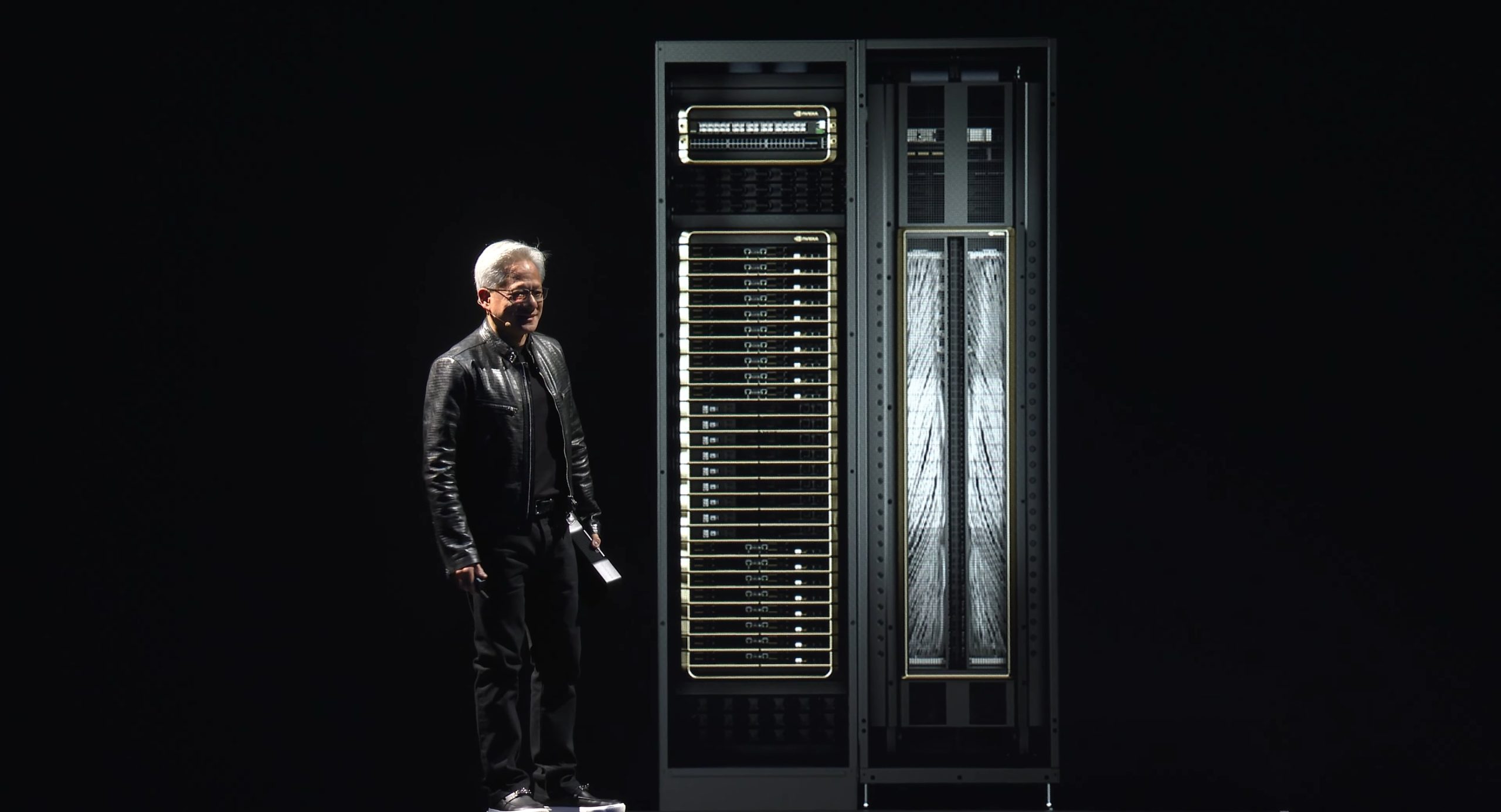
NVIDIA’s Blackwell Ultra GB300 NVL72 AI racks are reshaping how enterprises handle long-context AI workloads, delivering performance leaps that could redefine agentic systems. Unlike previous generations, the GB300 isn’t just about raw throughput—it’s about latency precision, a critical factor for real-time AI applications where delays cascade into inefficiencies.
The breakthrough comes at a time when AI models are pushing context windows beyond traditional limits, straining GPU memory and forcing architectures to adapt. NVIDIA’s response? A 50x improvement in throughput per megawatt over Hopper GPUs, achieved through extreme co-design. But the real test was in how the GB300 NVL72 handles the demands of models like DeepSeek, where VRAM bottlenecks often cripple performance.
To unlock its potential, the Large Model Systems Organization (LMSYS) deployed Prefill-Decode (PD) Disaggregation, a technique that splits workloads across nodes to avoid stalling during prompt processing or token generation. Combined with dynamic chunking and optimized KV cache management, the GB300 NVL72 achieved
- Peak Throughput: 226.2 tokens per second per GPU—a 1.53x jump over GB200.
- User Speed: Multi-Token Prediction (MTP) delivered 1.87x faster responses per user.
- Latency: A 1.58x reduction in processing delays, critical for agentic AI where split-second decisions matter.
These gains aren’t just theoretical. In latency-sensitive environments—like autonomous systems or real-time analytics—the GB300’s edge translates to near-linear scaling as workloads grow. That’s a stark contrast to GB200, where memory constraints often forced trade-offs between speed and capacity.
The implications are clear: for hyperscalers and neocloud providers, the GB300 NVL72 isn’t just an upgrade—it’s a necessity. While deployment costs remain higher than GB200, the lack of TCO discussions so far suggests the focus is on performance-per-watt efficiency, not just upfront expenses. NVIDIA’s bet is that in agentic AI, where responsiveness dictates success, the GB300’s latency dominance will outweigh other considerations.
What’s next? Expect further optimizations as LMSYS and NVIDIA refine disaggregation techniques, potentially extending the GB300’s lead in even more demanding scenarios. For now, one thing is certain: the race for AI infrastructure is no longer about brute force—it’s about precision.