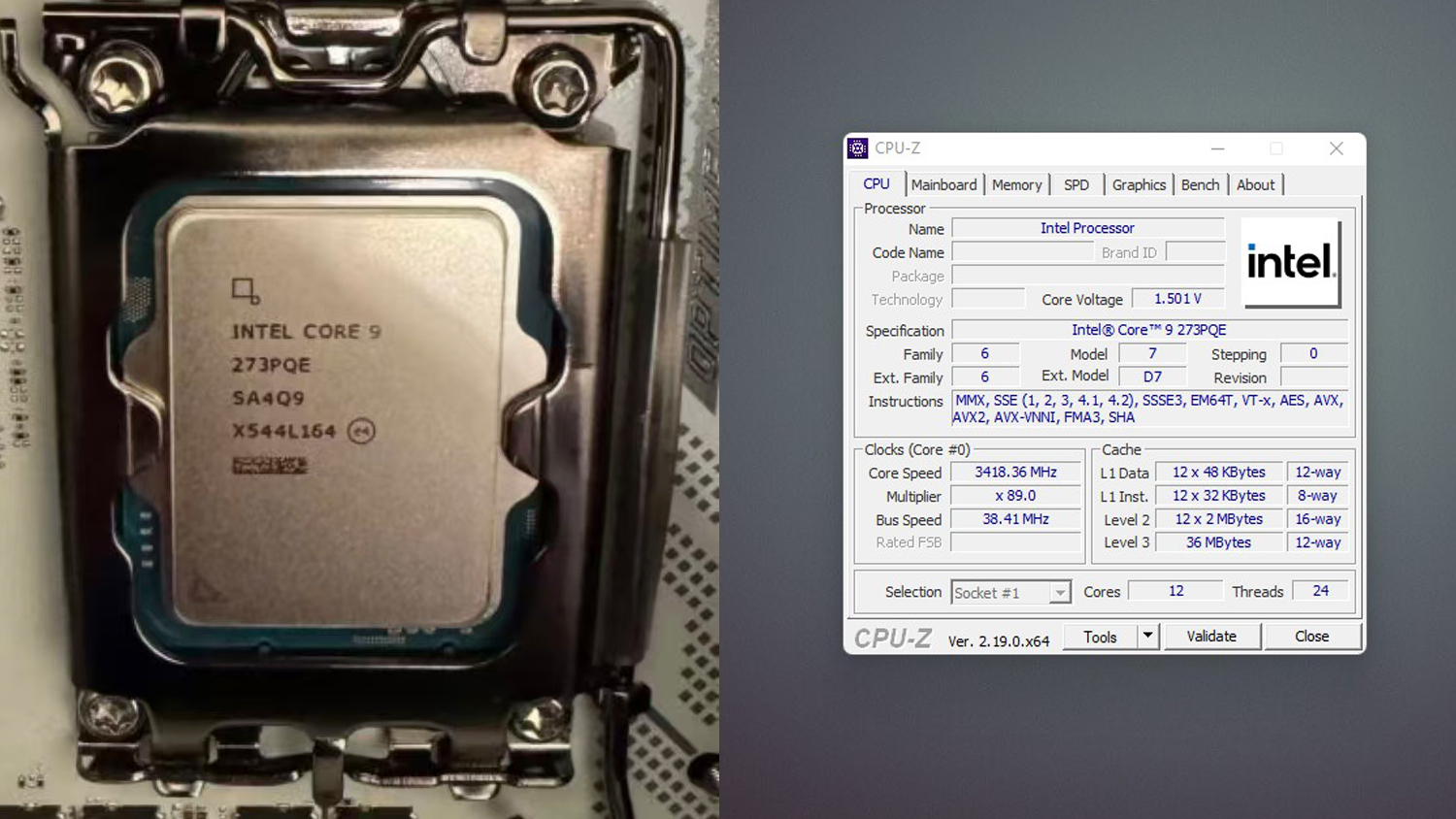
Intel’s latest desktop processor, the Core i9-273PQE, has quietly crossed another threshold in its journey from development to real-world use. A user has confirmed stable operation on a standard consumer Z790 motherboard, a feat that until recently seemed unlikely given the chip’s initial design constraints.
This breakthrough is not just a technical achievement; it signals a shift in how high-performance desktop components are integrated into mainstream builds. Historically, processors at this tier required specialized hardware to function, often limiting their adoption outside of professional workstations or overclocking setups. The Z790 platform, already known for its flexibility and support for next-generation Intel chips, has now proven capable of handling the i9-273PQE without modification.
Performance in Practice
The Core i9-273PQE is built on Intel’s 18-core, 26-thread architecture, with a base clock of 4.0 GHz and a turbo boost reaching up to 5.9 GHz. It pairs with up to 128 GB of DDR5 memory running at speeds of 5600 MHz or higher, though real-world performance depends heavily on both the motherboard’s implementation and cooling solutions.
- Base Clock: 4.0 GHz
- Turbo Boost Max Frequency: 5.9 GHz
- Cores/Threads: 18 / 26
- TDP: 170 W (junction), 233 W (PL1), 245 W (PL2)
The user’s setup included a Z790 motherboard from a major manufacturer, a high-end air cooler, and DDR5-6000 memory modules. While the system ran stable under load, some caveats remain. For instance, sustained overclocking beyond stock frequencies required fine-tuning, and certain BIOS revisions initially caused instability. These issues are not unique to this processor but reflect the broader challenges of pushing consumer hardware to its limits.
Broader Implications
The success with the i9-273PQE suggests that Intel’s roadmap for desktop processors may be aligning more closely with consumer expectations. Previously, enthusiasts seeking this level of performance often turned to server-based platforms or custom motherboards designed for extreme overclocking. The Z790 platform’s ability to support such a processor without those workarounds could democratize access to high-end computing power.
However, practical adoption will depend on several factors beyond just compatibility. Cooling remains a critical consideration; the i9-273PQE’s thermal design power (TDP) is substantial, even in its base configuration. Users will need robust cooling solutions to maintain stability under prolonged workloads. Additionally, while the Z790 motherboard in question handled the processor without issue, not all consumer-grade boards may offer the same level of support. Future BIOS updates and hardware refinements could further smooth this transition.
The milestone achieved with the i9-273PQE is more than a technical curiosity—it’s a glimpse into how desktop computing is evolving. As processors become more powerful, the line between consumer-grade and professional-grade hardware is blurring. For creators and power users, this could mean greater flexibility in building systems that balance performance with practicality.
For now, the i9-273PQE remains a niche product, but its compatibility with mainstream motherboards sets a precedent. If more processors follow this path, enthusiasts may soon find themselves with far fewer compromises when pushing the limits of their builds—without needing specialized hardware to do so.